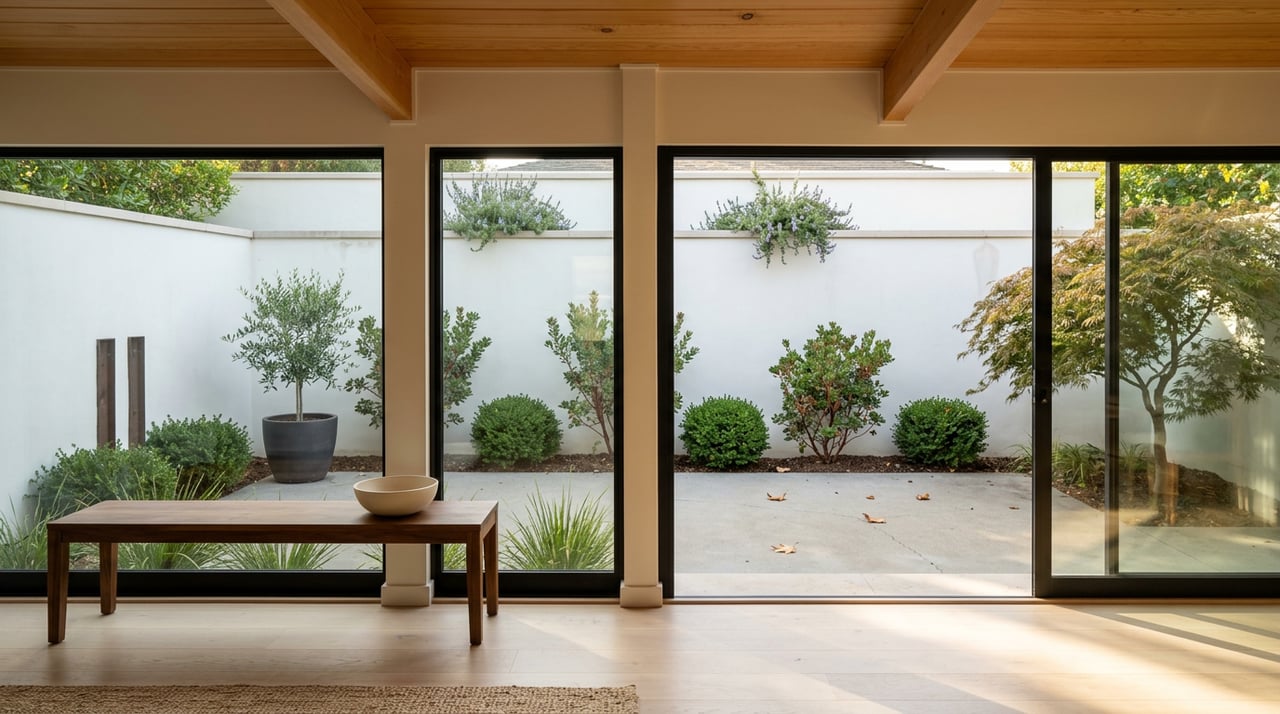
Most Palo Alto sellers assume the biggest variable in their listing strategy is presentation. For an Eichler, presentation matters, but it is not the variable that moves your net proceeds the most. The variable is your build year, and the second is the two lines of city code that govern what a buyer's future contractor is allowed to draw.
Those two facts, decided decades before you owned the home, shape which buyer pool shows up on tour day, how a slab-mounted radiant system is priced in inspection negotiations, and whether an offer clears at a strong ratio or gets talked down. Everything else in an Eichler sale is downstream of them.
The build year is the first line of your strategy
Palo Alto has more Eichlers than any other city in the Bay Area, roughly 2,700 homes across tracts including Greenmeadow, Fairmeadow, Green Gables, Charleston Meadow, Channing Park, and Los Arboles. On the outside they look similar. On the inside, the pipe running through your slab is not.
Eichlers built during the early-1950s Korean War copper shortage were plumbed with steel piping, which corrodes over decades. Eichlers built before that window, and most built after it, used copper, which can keep running almost indefinitely if it has not been mechanically damaged. That single distinction changes how a buyer's inspector talks about your radiant system, and how you should preempt the conversation.
A useful way to hold the picture as you prepare to list:
| Consideration | Where it lands |
|---|---|
| Original pipe material by era | Steel through the Korean War copper shortage window; copper before and after |
| Radiant repair economics | Spot repairs generally run in the low four figures; full system replacement can start around $20,000 to $40,000 and climb |
| National Register historic status | Green Gables and Greenmeadow, listed in 2005 |
| Single-story overlays confirmed | Greenmeadow, Green Gables, Los Arboles, Triple El, portions of Duveneck/St. Francis, Midtown, Adobe Meadow/Meadow Park, Garland Park/Charleston Meadows, and parts of Barron Park |
| Two-story path where allowed | Objective Design Standards adopted February 2025, or the discretionary Individual Review process |
If you are selling in Greenmeadow or Green Gables, the historic-district framing is a marketing asset, and it also narrows what a teardown buyer can propose. If you are selling a 1951 or 1952 tract home with original steel piping and no upgrade history, your pre-list plan needs to account for that in a way a Willow Glen bungalow simply does not require.
What the overlay actually does to your buyer pool
A single-story overlay is a real zoning tool with legal force, distinct from the city's voluntary Eichler Neighborhood Design Guidelines. Where it applies, a buyer cannot add a second story regardless of what standard R-1 allowances might otherwise permit. Greenmeadow and Green Gables are the most cited examples, with several other tracts adopting the overlay after roughly 70 percent of homeowners petitioned. Palo Alto has been layering these zones since it introduced the ordinance in 1992, and Planetizen has tracked the pattern of tract-by-tract adoption for a decade.
For the seller, this is not a nuisance detail. It filters your audience in a specific direction. The buyer who wanted to demolish and build a 4,500-square-foot two-story is not making an offer on your Greenmeadow home. The buyer who wants to restore mahogany paneling, keep the atrium, and add a permitted single-story addition is. That is a design-savvy pool, often willing to pay a premium for originality, but also more attuned to condition and finish detail. Your prep decisions should follow that reader, not a generic luxury buyer.
Outside the overlay tracts, the buyer pool splits. Some tour with a preservation lens; others are running the math on a rebuild. Pricing and presentation strategy diverge accordingly.
The February 2025 rulebook most sellers haven't priced in
Palo Alto adopted Objective Design Standards in February 2025 for two-story residential projects. Where an Eichler is not covered by a single-story overlay, a buyer weighing a future second-story addition now has two paths: comply with the prescriptive Objective Design Standards and proceed without a public hearing, or go through the discretionary Individual Review process, which involves public noticing, neighbor comment, and a hearing before the Planning Director. Custom Home Group notes that Individual Review typically adds four to eight weeks and introduces the possibility of conditions or denial.
Why this matters to a seller: the length and certainty of that permitting path is embedded in what a buyer is willing to pay today. If your tract permits a two-story path under the new objective standards, a savvy listing agent can walk a builder-adjacent buyer through the shorter timeline in the offer negotiation. If your tract is covered by an overlay, you steer the story the other way, toward preservation value and the National Register context if it applies. The City of Palo Alto's Eichler Neighborhood Design Guidelines are the reference document for both conversations.
Pre-list moves that change the negotiation
The Eichler-specific work that pays off before you go active is not staging. It is documentation and disclosure that neutralize the two or three questions every serious buyer's inspector will ask.
- Pull permit history and radiant-repair records. If prior owners replaced sections of the slab loop, patched roof membranes, or upgraded the electrical panel from a 60 or 100 amp original, gather the paperwork. Palo Alto Online's coverage of Eichler upkeep quoted radiant specialists placing typical repairs in the $500 to $1,500 range and replacement at $20,000 to $40,000 or more; a well-documented repair history moves your home from "unknown" to "priced."
- Commission an Eichler-experienced inspection before you list. A generalist inspector will flag standard concerns; an Eichler-experienced one will tell you which are structural to the design and which are actual defects. The Eichler Network service directory lists specialists including Bay Area Plumbing & Heating, Palo Alto Glass for original-profile window and slider replacements, Ventwerx for ductless HVAC retrofits, Eichler Siding for the original grooved profile, and Klopf Architecture and Keycon for renovation planning.
- Verify your tract's overlay and historic status in writing. If you sell in Green Gables or Greenmeadow, the 2005 National Register designation is disclosure and marketing at once. If your tract has a single-story overlay, confirm the code section so buyers do not spend the option period second-guessing what they can build.
- Address the roof and drainage conversation first. The flat or low-slope profile ponds water more than a pitched roof. A recent foam roof or documented membrane maintenance closes a line of buyer objection before it opens.
- Decide, deliberately, whether to leave the radiant system as-is. Some buyers view an original working system as a feature; others see the phrase "slab leak" and mentally deduct. If yours is copper-era and functioning, a recent service report is often more persuasive than a preemptive replacement. If it is steel-era with a repair history, obtaining a heat-pump retrofit quote from a specialist gives the buyer a concrete number rather than a fear.
What the current market rewards
Palo Alto in mid-2026 is a market that pays for prepared listings. Homes selling in May 2026 moved at a median around $3.6 million with roughly twelve days on market, and the sale-to-list ratio in the first quarter ran above 107 percent. Those are aggregate numbers across all Palo Alto housing, from Old Palo Alto Craftsmans to Barron Park contemporaries. Within the Eichler cohort, the dispersion is wider. A restored copper-era Eichler in a National Register tract, professionally marketed, tends to clear the top of the range. An original-condition steel-era home listed without pre-inspection or documentation trades on the buyer's uncertainty, not on the architectural premium.
The point of the pre-list work is not to hide the home's age. It is to move every open question into a documented answer, so the offer negotiation is about price and terms, not about what might be under the slab.
A short FAQ
Does a working original radiant system add value, or subtract it? Both, depending on the buyer. Purists read a maintained copper system as part of the home's authenticity. Generalist buyers can read the same feature as a maintenance risk. A current service report from a named specialist neutralizes the risk framing.
If my Eichler is in a single-story overlay, am I losing the teardown premium? You are losing the two-story rebuild buyer, not the value. Overlay tracts have generally held their character and, in the case of Greenmeadow and Green Gables, gained historic-district cachet. The buyer pool is different, not smaller in a way that hurts pricing on a well-prepared home.
Should I upgrade the electrical panel before listing? If the panel is still an original 60 or 100 amp and you have time, yes. A modern service capacity removes a common financing-side objection and supports future heat pump or EV charging plans the next owner will assume.
Is the February 2025 Objective Design Standards change relevant if I am just selling, not remodeling? Yes, indirectly. It shortens the permitting path for buyers who plan a future second-story addition where zoning allows one, which supports offer strength on non-overlay Eichler lots.
Selling an Eichler in Palo Alto rewards the seller who treats the home's architectural specifics as a story to tell rather than a set of problems to hide. At Suzanne O'Brien, that begins with a conversation about your tract, your build year, and the two or three documents that decide how the first offer is written. Request a complimentary home valuation and market consultation to map the listing strategy your Eichler actually calls for.