What happens when a Los Altos Hills seller's septic inspector finds a failing leach field in the first week of November?
In most Bay Area cities, the answer is straightforward: call a licensed contractor, pull a permit, fix it, close on schedule. In Los Altos Hills, the answer involves a calendar the town itself enforces. The Town's septic bulletin prohibits new septic installation or repair work between November 1 and April 1, with emergency exceptions only if the property owner gets an erosion control plan approved first. A seller who discovers a problem in late October can find themselves locked out of a normal repair timeline until spring, watching escrow stretch or collapse over a system no one can legally touch for months.
That single rule says something bigger about how this town works. Los Altos Hills was incorporated to stay low-density and rural, and that founding choice means two of the most consequential systems in any home purchase, the road to the driveway and the wastewater system under the lawn, are not run by a city crew. They are run by the owners, under agreements and bulletins that most buyers never read until they are already in contract. The due diligence burden here is not a formality. It is the entire safety net.
The road to your driveway is a private contract, not a city service
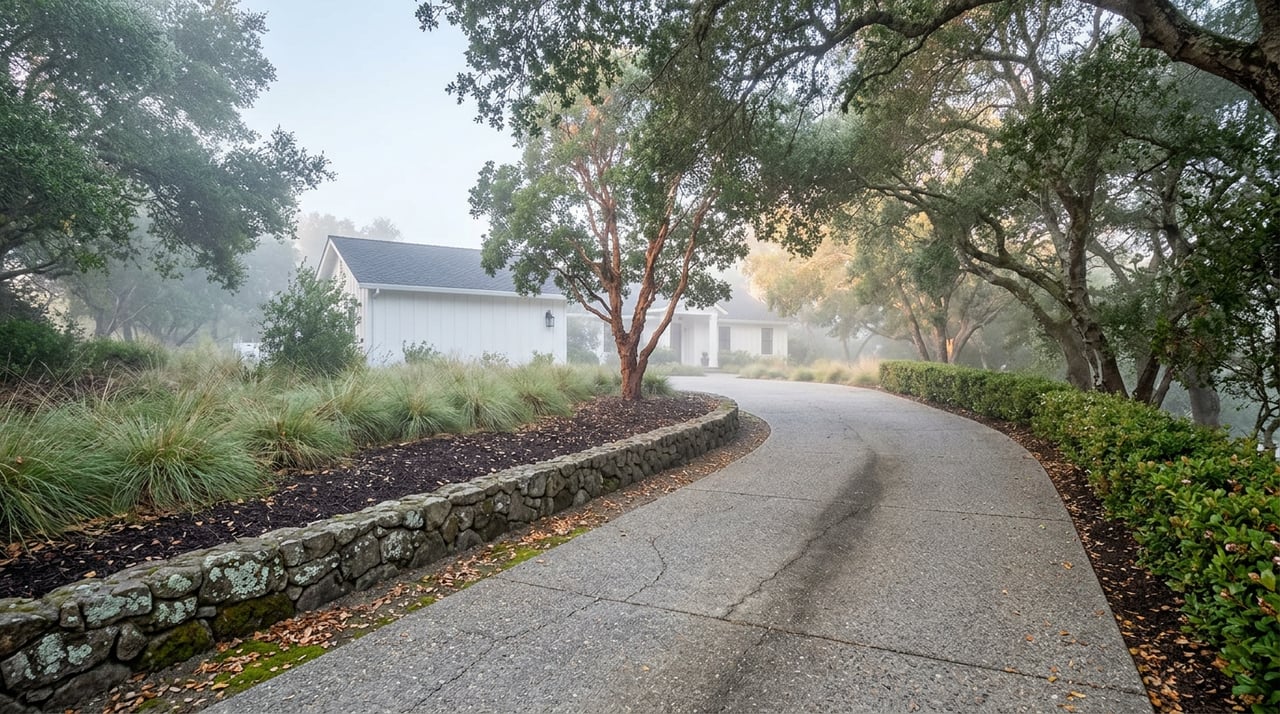
Long private driveways and shared roads are common across Los Altos Hills, and many of them operate under a recorded Private Road Maintenance Agreement. The Town publishes a standard template for exactly this purpose, and it is worth reading before you fall in love with a property rather than after.
Under the template, a group of owners who share access to a private road elect a Road Commission Agent, who opens a bank account, collects funds, and pays for maintenance, improvement, and emergency repairs. Costs are split pro-rata among participating owners according to a formula the group has to agree on themselves. If an owner does repair work without majority approval first, that owner absorbs the cost alone. Disputes go to binding arbitration, with each owner getting one vote to select the arbitrator, and the agreement can be enforced not just by the group but by the Town's City Manager directly.
That last detail matters. It means the town has a stake in these agreements functioning, but it does not mean the town is paying for your road. Compare that to what the town does fund: the FY 2025-26 Pavement Rehabilitation and Drainage Improvement Project, an annual program that resurfaces and repairs public streets using SB1, SB83, Highway Users Tax Fund, and VTA Measure B dollars. This year's cycle ran from early May through the end of June. That program exists for public roads. If the road serving a property is private, which is the case for a meaningful share of Los Altos Hills parcels, none of that funding touches it. The condition of that road, the cost of fixing it, and the process for deciding when it gets fixed all live inside whatever agreement the current owners signed, sometimes decades ago, with an allocation formula that may or may not still make sense for the current group of neighbors.
For a buyer, this means the recorded agreement is not paperwork to skim. It is where you learn who else is paying, how disputes get resolved, and whether the group has actually been funding a maintenance account or letting it run dry.
The county next door has a rule Santa Clara County doesn't
Buyers moving into Los Altos Hills from other parts of the Bay Area sometimes carry an assumption that turns out to be wrong here: that a septic system gets inspected as a matter of course before a sale closes. That assumption comes from real rules, just not this county's.
Santa Cruz County adopted a point-of-sale septic ordinance effective July 1, 2023. Under that rule, any property served by an onsite wastewater treatment system must have a septic inspection and pumping report completed before the sale closes, valid for 12 months, with the seller responsible for the inspection and any required repairs unless a Transfer of Responsibility form shifts that obligation to the buyer.
Santa Clara County's septic ordinance, which governs Los Altos Hills, took effect back on December 26, 2013, and it does not include that same point-of-sale inspection mandate. There is no county rule that forces a septic check before a Los Altos Hills sale can close.
| Santa Clara County (Los Altos Hills) | Santa Cruz County | |
|---|---|---|
| Point-of-sale septic inspection required | Not mandated by county ordinance | Mandated since July 1, 2023 |
| What triggers a septic check | Buyer or seller request, lender requirement, or standard disclosure practice | County code requires it for every OWTS-served transfer |
| Who typically orders it | Seller, by choice, or negotiated in contract | Seller, by county mandate |
| Repair timeline if a failure is found | Negotiated between the parties | Repairs generally required before closing, or a Transfer of Responsibility with a 90-day window |
This is not a smaller risk than a county-mandated inspection creates. It is a different one. Without a county rule forcing the check, septic condition in Los Altos Hills rides almost entirely on the standard Transfer Disclosure Statement and Seller Property Questionnaire, which require sellers to disclose known material defects but do not require an independent test to surface problems the seller does not already know about. A seller who has never had the tank inspected has nothing forcing that inspection to happen before you sign. The absence of a mandate shifts the entire job of finding out onto the buyer's own due diligence, not onto a form the county requires by default.
What this changes about how you shop and how you sell
None of this is a reason to avoid Los Altos Hills. It is a reason to treat two specific document requests as non-negotiable rather than optional, whichever side of the transaction you are on.
- Request the recorded Private Road Maintenance Agreement for any property on a private road, and read the cost allocation formula and the maintenance account balance, not just the existence of the agreement.
- Order an independent septic and, where applicable, well inspection during the contingency period, treating it as standard practice rather than something you wait to be told is necessary. Santa Clara County's Department of Environmental Health can provide existing as-built records to work from.
- If you are selling and any septic or well work might be needed, get the inspection done well before listing. Discovering a problem in October, when the town's own repair window has already closed for the season, is the worst time to find out.
- Ask whether the road serving the property is public or private before you get attached to the property. It changes who pays for what for as long as you own it.
For sellers, this is also where preparation pays for itself. A septic system inspected and, if needed, repaired before June gives you room to actually fix it under the town's own rules, rather than negotiating repair credits with a buyer while the calendar works against you. A private road agreement with a documented, funded maintenance account is something you can hand a buyer as proof the system works, not just a recorded document that exists.
A short FAQ
Does Los Altos Hills require a septic inspection before I can sell? No county ordinance mandates one, unlike Santa Cruz County's point-of-sale rule. Standard disclosure obligations still apply, but the inspection itself is not automatic. Ordering one yourself is the only way to know what a buyer's own inspector will find later.
Can septic repairs happen at any time of year? Not for new installation or repair work. The Town's septic bulletin prohibits that work between November 1 and April 1, with emergency repairs allowed only after an approved erosion control plan.
Who pays to maintain a private road in Los Altos Hills? The owners who share access to it, under a recorded Private Road Maintenance Agreement, with costs split pro-rata according to whatever formula the participating owners agreed to.
Does the town's annual road paving program cover private roads? No. The town's road rehabilitation program, most recently the FY 2025-26 Pavement Rehabilitation and Drainage Improvement Project that ran May through June, resurfaces public streets only. Private roads are maintained and funded entirely by the owners under their recorded agreement.
Estate properties in Los Altos Hills reward buyers and sellers who treat the road and the septic system as seriously as the house itself. If you are weighing a purchase or preparing to list and want a clear read on what a specific property's private road agreement and septic history actually say, Suzanne O'Brien can walk through the documents with you before you are past the point of easy questions. Request a complimentary home valuation and market consultation to start with the facts on your specific property.